If you happen to have a copy of my incense recipe for Loki, throw it away and don't use it. In my ignorance, I included cinnamon which is toxic to burn. Please, for the love of what is holy and the good of your health, don't burn cinnamon. It can have very negative effects on you if you breathe it in.
It's hard to keep up with the witchy neighbors who have the luxury of a full apothecary, garden, and an on-line subscription to the ritzy places that sell every spell component you could use plus a few you really shouldn't. If you are like me, you try to keep a garden but the neighbors keep pulling flowers, dumping cigarette butts in it, and throwing garbage into the deeper foliage. Also, if you are like me, you have a limited capacity for indoor plants, with one specific plant trying to conquer the world no matter how many cuttings you give away.
It gets frustrating when you read a spell that calls for exotic things like frankincense. While bay leaves are relatively less expensive than frankincense, the cost of those bottles of spices add up quickly. Especially if the spice/herb you are using is of limited supply because of all these supply chain issues we've been having since COVID-19 arrived on the scene.
For example, prior to COVID-19's impact on the worldwide supply chain, I was using Turkish Rosewater (which was a bit expensive but less expensive than other brands) as an offering to Déa. Now, I haven't been able to find it anywhere for the last two years. I don't know if it will be back in stock or not. I attempted to cultivate some roses and make rosewater with it but it failed horribly. As such, I am replacing the rosewater offering with plain, clean drinking water.
When it comes to spices and herbs that spells have required, I have been watching the prices go up. As such, I turn my attention to the plants in my area and what information the herbals I have gives me about their traits. Bay leaves are starting to get a bit pricey in my neck of the woods, but I found an alternative that is not toxic if you burn it. Willow leaves. They're just long enough to write a word or a small sigil on them. You can't exactly add them to recipes. But you can make sachets with them and use them in place of bay leaf. And willow is a gentle, healing tree that can be used for healing magic and helping one to sleep.
One thing that you should be careful of in foraging for spell components is that you are not getting mixed up with poisonous plants, like poison ivy, poison oak, or hogweed. These are three plants you do not want to come into contact with, especially the hogweed. And you most definitely do not want to burn them, because the smoke is just as toxic as the oils in the leaves if not more so. Also, check your plants closely because hemlock (which is an invasive plant in my region) looks virtually identical to wild carrot. The difference between the pair is subtle. A pictorial guide to your local flora and fauna is a very wise thing to take with you when you are foraging. Investing in books like this are a worthy thing to do, and just as 'witchy' as buying herbals. It keeps you from poisoning yourself or others. It gives you something to look at and compare with what is in front of you. And it helps you become more proficient in herbalism and herb magic by deepening your awareness of the plants you are working with.
I apologize that this post is a day late. I'm still trying to reorient myself timewise after being sick for about a month. If you're like me you don't have an extravagant budget to get all the latest herbal products recommended by the big name folks in the pagan and witchcraft community. Don't panic or think you can't do that money drawing spell that you planned to help your budget a bit. You have options that you may not have realized were there.
Now before I give you a list of some of these options for you to consider, I want to recommend a couple of books that have been extremely helpful in my process of 'wildcrafting' magic. I honestly don't know why folks call it wildcrafting when it's the way it has been done since antiquity. Intimate knowledge of the land and what is there to use is how everything was done in the 'old days'. (Now, I won't say that the old days were better, after all people were dying of curable disease because they didn't have antibiotics, for example.)
The first book I am going to recommend to you comes in two volumes. I can't recall if it is still in print, I think it is. It is M. Grieve's A Modern Herbal. This book is a bit dated as it was initially published in the 1930s, but Margaret Grieve took an academic approach to her topic matter that is timeless and easily understood. This book also has some print images in the style of James Audubon's artistic images of plants.
The next book I recommend is more current (having come out in the early '00s). The Nurse's Guide to Herbal Remedies is a book chock full of information that ranges from how to use a given herbal remedy to medications derived from it and things that contraindicate with it. I can't recall the author. The book got stolen from me about three months after I got it. To say the least I wasn't pleased. I may have the title wrong, but that is what my gut is telling me is correct.
The third book I recommend is The Encyclopedia of Medical Plants from Andrew Chevalier. This book has high quality illustrations of the plants that he discusses. It's basically a step down from The Nurse's Guide to Herbal Remedies. It does not get into what medications you should not mix it with or what medications are derived from it. But it does tell you what a given plant is used for, what parts are used, and how to prepare them for use.
Finally, I recommend is Cooking with Herbs and Spices by Andi Cleve, et al. This is a book I cross reference with the Encyclopedia of Medical Plants. It works very well to allow me to use my spice cupboard to treat minor ailments. While herbalism is awesome and can work very well, it is a supplement to modern medicine, not a substitute.
With these four books in your library, you have the ability to step outside and look in your own yard or garden for the plants that will help you. In some cases, however, you need to check with your state's department of environmental conservation to make sure that what you're planting isn't an invasive plant in the region. If it is, put it into a pot and keep it under close watch. Don't allow seed pods to fall into your garden or fluffy seeds blow off to the four corners.
It's the holiday season and one of the most popular decorations out there is mistletoe. It is a plant that is found on trees like oak where it has put its roots into the tree and lives off of the sap of the tree. Mistletoe is perhaps infamous for its role in Norse mythology but this time of year the Victorian kissing ball of mistletoe is what reigns supreme. According to 'tradition' if you kiss a person beneath a sprig of mistletoe they will be your true love in the coming year.
It's a poetic and romantic notion. It also completely ignores the dangers of mistletoe. All parts of this plant are toxic. The pretty white berries are perhaps the most toxic part of this plant. If you choose to acquire a kissing ball, get one made of faux mistletoe. If a berry drops and a small child or curious pet eats it, it can kill them. Play on the safe side of this decoration and go with something that you just have to dust off and hang up next year.
My garden is overflowing with apple mint. It's a wonderful plant that has a lot of the same properties of regular mint. It just has a subtle apple aftertaste. Apple mint goes wonderfully with ham. It can be dried and used to make a soothing and relaxing tea that helps with sore throats, just like regular mint. In the dried state, apple mint's apple-like notes are not as strong. This seems to be the reverse of what usually happens when you dry something. I don't know why. It could be there's a problem in my drying technique.
I'd post a picture of my garden right now but it's raining. Apple mint is a plant that can be started from a cutting rooted in water. I have found that if you root it in water, you'll want to plant it shortly there after. You don't need to apply rooting hormone to get this plant to put out roots. In the ground, apple mint produces runners and will spread that way to take over your garden. If you don't want apple mint popping up in the middle of your hostas like mine is, when you plant it, put it into a bucket with some holes in the bottom. Make sure the bucket is deep enough that the runners can't get out the holes at the bottom. Then your mint will fill up the bucket and not take over the garden.
This week's subject line is a bit vague. That is because I am covering a broad topic that I have only recently gotten into studying. Almost every witch or nature enthusiast is going to have houseplants. They're lovely to look at. They clean the air of our homes. And tending them can be great for your stress levels.
There's a lot to recommend indoor gardening (as Beloved calls it) as a hobby. It is, however, very important to keep in mind that many popular indoor plants are not safe for children or pets (or anybody) to consume. I'll give you an example. I currently have a Kalanchoe that looks fabulous. It is one of the most toxic plants that I own. When they're in flower, the toxic compounds of the plant are concentrated most in the blossoms. If you have a pet that likes to nibble on green things, this can kill them deader than a door nail. Kalanchoe poisoning causes stomach cramps, vomiting, and heart failure. If someone or something gets into the plant, you have about 24 hours before it's lethal. Beautiful plant with jade green leaves, very easy to take care of and propagate, and absolutely toxic.
If you have plants in your home that you're not sure are toxic to your family or pets, you should investigate them before you put them at a level where they can get at them. It was only by pure luck that I stopped my son (when he was a toddler and thought all things green equal lettuce) from eating a leaf off of my Golden Pothos. This could have made him extremely sick and put him into the hospital. Since then, I have my plants hanging and have taught my kids that the plants that they eat are the ones that we give them out of the fridge or from the garden. It was a scary moment when I learned later just how sick my 3 yo son could have been.
Now, when I look into purchasing houseplants, I don't just look up how to care for them but also how toxic they are. This determines where I put them and if I allow my children access to them. Some of my plants, if the stems are broken, will exude a sap that can cause an allergic reaction. So, I handle the watering of those plants while the boys handle the watering of the ones that are safer. It is a bit of extra work to find out if that pretty plant in the grocery store is safe but it is completely worth it to prevent a hospital trip or worse.
I love my houseplants and they make me very happy. At the same time, I handle them with care and respect for the potential danger that comes with them. It is funny, to be honest, 98% of the plants in my apartment are somehow toxic where as 98% of the plants growing out in the garden are edible. I think I somehow got it backwards.
I apologize for this post being a day late. Family business had me running about town and getting errands done most of the day. Kitchen witchery is more than a cozy aesthetic. It can be an inexpensive and highly functional way to get spell work done. Many of the spices in your cupboard have magical associations that have been forgotten about.
I can't give you a full list of spices and associations because I don't have a complete collection of herbals. What I can do, however, is point you in the direction of some good resources. Before I do that, I want to explain why spices and herbs are a great tool to use in your magical work. First off, they're easily accessed from your local supermarket or grocery store. You don't have to go foraging and worry if what you're collecting is an endangered plant or not. Secondly, unless someone has a specific food allergy, they're safe for use in all forms of spell craft, including things that are going to be consumed or put upon the skin.
A well stocked spice cupboard is going to include things like Tarragon, which is a plant known to help with psychic abilities and ease with sleep. An older name for Tarragon is Mugwort. You may have seen things that call for Mugwort. There is multiple plants that go by this name, Tarragon is the safest to use and is very gentle in its effects. Other items in your spice cupboard can be used to create incense, which can save you big money down the road. (I have an incense blend for Loki that is a combination of clove, cinnamon, and dried ginger. I put a pinch of the ground spices onto a bit of smoldering charcoal and it smells wonderful.)
It is important to recognize if you are using herbs and spices as alternative medicine that you should consult with your doctor. Almost every herb and spice has some form of medicinal use at correct proportions. Fenugreek, for example, is known to help with gas and is said to help nursing mothers increase their milk production. It can, however, interact with medications that you are on. Don't worry about bringing up the use of herbs and spices in your efforts to be proactive in your health. Today, there is a legion of doctors, nurses, and pharmacists who are trained to know what herbs will interact with what medications. (This includes food too, as I'm on one that I had to give up grapefruit because it causes liver problems with the medication I'm on. It was my pharmacist who explained that one to me.)
Looking up the uses of herbs and spices in a magical and medicinal purpose is challenging. There's a lot of conflicting information out on the internet. I would recommend one begins with actual books that have been published on the topic. While Culpepper's Herbal is interesting, it should be regarded with some caution because it was written long before we understood how medicine worked. M. Grieve's A Modern Herbal (it's two volumes) is a bit dated because it comes from approximately the WWI / WWII era. It does, however, contain a great deal of information on how to use a wide range of plants, including herbs and spices in your work. The best book I can recommend is The Encyclopedia of Medicinal Plants from Andrew Chevallier. This book covers the science and the history of the use of a wide range of plants (a large number of them being herbs, spices, and edible ones).
There's a lot of recipes for spell bottles and potions kicking around on the internet. Please take the time to seriously investigate what you're putting in there is safe. Different herbs can be deadly (i.e. Belladonna Atropos has earned it's name because it can kill you with a rather small dosage.) and different chemical combinations can be lethal as well (i.e. do not mix urine with bleach, you will get chlorine gas and can die).
When I am making my spell bottles and potions, I use materials that are safe to handle with bare hands. I research what the chemical and medicinal properties of the components I am using, because sometimes even inhaling a small amount of the particulates kicked up as you're grinding them in your mortar and pestle can have an effect on you. My go to book for information on the medicinal properties of herbs is a bit dated. It is M. Grieves's A Modern Herbal. I have the earlier, two volume edition. Either way, you get a lot of really good information on how to use the herbs listed in the book(s) safely and some indications of what they don't work with.
I also will check with my pharmacist before making any sort of thing that I ingest if the herb is safe for consumption. Part of your local pharmacist's education is alternative medicines. I had a book that listed the drug interactions for most of the popular herbs used but the book got borrowed and never came back. I can't even remember the title of it, but it was for the folks in the nursing program where I went to college.
Remember the argument that something is natural therefore its good for you is completely garbage. Hogweed is natural and cause horrific results just brushing up against it. Poison Ivy is natural but is the bane of almost everyone in my region except for the damn deer who eat it like candy. (I am exasperated with the deer population because it is so high that they're a menace. Why is it so high? Because we've pushed out and killed the natural predators that controlled the population. They're slowing being reintroduced but the deer still out number them in a big way.)
Be cautious about what you use in your spellwork, your potions, and consumables. Even your spice rack can be problematic. Fennel, for example, is great for encouraging milk production in lactating people but it will wreck havoc on you if you have gall bladder issues. (Found that one out the hard way, do not recommend -67/10.) If you have underlying health conditions that require you to take prescription medications, always check with your pharmacist or doctor before starting some kind of herbal medical regime. Lots of herbs will interact with prescription medication and such because they are the original source for other prescription medications. Valerian, as another example, is a sedative that can cause the same issues as taking Benadryl (drowsiness, dizziness, and difficulty operating heavy machinery) and you don't want to take it along with other medications or herbs that do the same effects because it will amplify them. (Yes, friends, that herb can put you to sleep for good if you take too much of it, so be very careful with your home remedy sleep aids, please.)
If you want to make potions and such, do it from a position of informed safety. All knowledge is worth having. Especially if it allows you to keep your health.
Chamomile tea has a long history of being helpful for digestive issues. It's excellent for this purpose but it also has magical properties that makes it very helpful for other things. Chamomile is an herb that can promote good sleep. It is also an herb that helps one have prophetic dreams. Folk medicine has prescribed this herb for its calming effects for a long time. When blended with other herbs used for psychic work, chamomile can be a gentle guide into a trance state.
In poppets, chamomile invokes Sun energy and the essences of serenity for the target of the poppet magic. In charm bags, chamomile does the same thing. It also carries with it the energies of prosperity and youthful vitality. Chamomile is also associated with the spirits of the land and the fairies.
One must take care with chamomile. It can cause allergic reactions because it is related to ragweed. It has also been shown to be a potential herb to induce labor for pregnant women. Interestingly, it has the opposite effect on women who are not pregnant, serving to gently ease meneustral cramps. It is not as effective in this purpose as raspberry leaf, but it can be helpful.
Chamomile is generally considered safe to consume in moderate portions on a regular basis because of its gentle effects on the body and the fact that interacts with so few medications on the market. If you are taking aspirin or other NSAIDs, you want to limit your chamomile intake to only a few cups of tea a week because it does interact with these medications.
There are ongoing pharmacutical studies to determine the medicinal properties of the many variants of chamomile used in herbal medicine. It has shown promise as an anti-anxiety treatment and as an anti-inflammatory treatment. These studies are on-going as of the time of this blog post. I am sure that in the near future, they will have a good deal about this apple scented herb figured out. In the meantime, be sure to consult with your pharmacologist and doctor before beginning an herbal medication regime to make sure that you don't have to worry about interactions or other nasty things.
Tea has a long standing history of being a drink with curative properties. It is a staple in almost every pantry and is equally popular as coffee for bringing a bit of energy to perk one up in the morning. Black tea is the most popular form of tea on the market. There are a lot of different varieties you can purchase. If you are engaging in blending your own teas, I recommend purchasing a tea strainer and using loose leaf tea.
Black tea has excellent magical properties. It works to help ground us when we are agitated. It works to give us energy when we are feeling depleted. It also has the capacity to act as a good carrier substance for other herbs used in magic. A pinch of mugwort plus a few pinches of black tea, for example, can give you a nice, gentle potion that will help you develop your psychic gifts.
Taste wise, black tea can be brewed quite strong. The tannins in the tea can cover up the less than savory elements of your potion. It is also something that brings out the floral flavor components when you add herbs such as lavender or chamomile when it is brewed to a mild degree. Strong black tea is very grounding. Weaker black tea is not as intense in its flavor profile, thus it lends itself to herbal blends that can work to lift you up out of your mundane state of consciousness.
A good general purpose tea blend that works to balance one's energy levels is one part black tea, one part mint, and one part chamomile. This can be sweetened if you desire or have milk added to it. The three herbs in this tea blend work together to ground your energy, clear your mind, and settle your body into a more relaxed state. (Chamomile has a long history of being good for digestive upset and settling the mind.)
As always, when using teas as potions or herbal medicine, consult with your doctor or pharmacist. You do not want to have any interactions between your concoction and medications you are on. You also want to measure your ingredients precisely to make sure that your 'dosage' is healthy for your build and conditions. Some herbal teas/medications can have adverse effects on the body despite their flavorful qualities. Raspberry tea, for example, can gently induce labor for a person in late stages of pregnancy even as it eases the severity of menstrual cramps for non-pregnant people.
If you crack open an herbal you'll find a lot of recipes for everything ranging from herbal teas to potions. Today's post is an attempt to clarify the differences between these different uses of herbs and note some safety protocol necessary in their uses. Before I move on to the details, I want to note something very important. If you are incorporating herbal medicine into your daily care regimen, keep your doctor and pharmacist apprised of the situation. Medicinal herbs and plants can have interactions with medications, some of them potentially lethal.
Now, preface made, let's get down to talking shop, shall we? Herbal teas are made with a base of black, white, or green tea. They contain a percentage of caffeine and other elements that can be good for your health. This is part of the reason why they're so popular. Herbal teas have set ratios of herbs to tea. Different brands of herbal teas will have different ratios and different herbs (even if they claim to be identical to other brands). Generally, commercial brands keep these ratios as trade secrets. After all, Bigelow doesn't want Celestial Seasonings to steal the recipes or vice versa.
When selecting a commercially prepared herbal tea, make a point of reading the ingredient list. There are herbs and spices that can evoke an allergic reaction despite the fact that you're not out in the wild sticking your face into the plant to smell the pretty scents. Chamomile, for example, is well known as a digestive aid but if you have hayfever, it is possible that you are going to have some stuffy sinuses after drinking a cup of chamomile tea because it is related to the plants commonly known for provoking hayfever allergies. In the case of teas for relaxation and rest, one must be careful because they can contain herbs such as valerian which can interact with cold medications and make you extra drowsy.
Tisanes are different from herbal teas. They are like teas and frequently marketed as herbal teas. The difference is a tisane does not have any tea leaf added to it. These have higher concentration of herbs and spices in them than herbal teas. This means that they can have a stronger effect on the body. The brewing process for a tisane is also different from the brewing process for most herbal teas.
Most herbal teas are brewed in the same manner of regular tea. Water is heated to near boiling (or boiling, depending on the tea used) and poured over the herbal tea before being allowed to steep for several minutes. Tisanes have a different process. Water is heated to near boiling and then poured over the herbs. At this point, the cup is covered to allow the steam to condense on the cover and drip back into the cup, thereby preserving the concentration of the active components of the tisane. The time to cover the cup varies between different tisanes and what is being used. They are, in general, steeped at least 10 minutes to get the maximum amount of the active components out of the herbs.
Potions are entirely different from herbal teas and tisanes. Most of the time, potions are not intended for consumption. They will use inorganic elements, such as crystals, and can prove highly toxic. (Point of reference: If you see a potion that calls for a combination of urine and bleach, don't use it. That produces dangerous amounts of chlorine gas and can kill you.) There are some potions that are made with edible ingredients and should still be treated with the same caution as herbal medicine because the herbs used in the potion will have an influence upon your body's ability to metabolize medications, vitamins, and even food.
In the end, the biggest thing I would like for you to take away from this post is that natural products are not always safe. Cyanide is natural and completely lethal. Be cautious in your approach to herbal medicine and consult with doctors and pharmacologists who have the training to tell you how your medicinal herbs will interact with your body. This is true for recreational herbal usage. If you're using herbs for fun and profit, make sure you do it safely and with consultation with the people who went to school to make sure you can survive the experience.
In my last post on this topic, I covered the various reasons why one would keep an herbal and the basics of what an herbal is. Now, it may be that you've decided to go the path of least research and acquired for yourself a small library of herbals published by others. If so, congratulations on your library and don't be surprised if it continues to grow just as much as your beloved plants. On the other hand, you may have decided you want to make your own herbal and compile information into a format that you prefer over what others has done. This is a fine task to take up but it requires some elements to remain in place regardless of the format you choose to record your information in.
First, you must have all identification information for the relevant plant in question. This goes beyond its various names. The includes a pictorial identification of all parts of the plant from the tips of the tops to the bottoms of the roots. Some may choose to use photographs for this purpose. Others may choose to write out the description in great detail (as seen in M. Grieve's A Modern Herbal, for example). If you are a skilled artist, sketching the plant has well established roots (if you'll pardon the pun) in the history of writing herbals. But, identification of the plant is vital.
Secondly, you must note what manner of location the plant may be found, the soil it prefers, and such. This way you can identify the plant based on where it is growing because Colt's Foot is not going to grow at the same place as Devil's Trumpet, and neither are going to be found where you can locate Cat's Tails. Knowing the growing conditions for your plant to flourish is helpful in foraging herbs and for growing them. One might even go so far as to include in this section a note referencing what plants you commonly find them growing with (or you can companion plant them with in your garden).
The third section on your plant's page is where the fun stuff goes. How does it fit into your magical classification systems? What recipes for its use do you have? What recipes have you collected? What folklore have you collected about the plant and what personal gnosis do you have about the plant's spiritual nature?
It may be that you have a love for green things. It may be that you have a pervasive curiosity about how to use those green things in your magical workings. If that is the case, you may want to keep a record of your experiments and use of green things. That sort of book is called an herbal. Now, herbals have been kept since antiquity. Some of the earliest known records of how plants are identified and used date back to the ancient Egyptians and the Romans. In many ways the format of the modern herbal was established by Linnaeus and his works discussing plant life. But, these books were influenced by their predecessors going back to the writings of Pliny and others.
Herbals hit peak popularity in Europe with the rise of printing (specifically moveable type). They are experiencing a resurgence in popularity with the increased use of alternative medicines based in the use of plants. If one is looking to purchase an herbal for the sake of knowledge and getting some manner of an idea how to use a wide range of plants, the author recommends M. Grieve's A Modern Herbal. While this text is dated, the author has yet to encounter another modern herbal that is as complete in its discussion of the plants contained therein.
Creating your own herbal is a challenge. One must first identify the plant they are working with. The Audubon Field Guides to North American plants are an excellent resource to identify the plants in North America (the author's home region). In the identification process, one must determine the toxicity of the species in question. Some plants and fungi are so toxic that handling them with out gloves is not recommended. Notation on the identification of the plant and its toxicity is vital for safe usage of the plant.
Following this, one must consult other established herbals and books that use wild foraged plants for recipes. It is possible to copy recipes from these sources, but the author just finds it easier to keep a copy of the source material on hand. This is part of the reason why the notebook that was supposed to be a self-made herbal has a total of a half dozen entries. The practice of copying notes can be meditative and relaxing, for some people, and there is merit to having the recipes that you use the most in one notebook instead of having to search through a small library to find out how to make something such as rosewater.
If your witchcraft practice includes herbs and plant parts, it's positively vital to keep things organized. On the plant, the berries of nightshade are fairly easily identified. You have the rest of the plant to go by. Off the plant and dried, nightshade looks a like any other dried tiny red berry. This has potentially lethal consequences if you like to make herbal teas and you're including some manner of dried tiny red berry. There's a reason why they call it deadly nightshade, after all.
Not only is it important to organize and label your herbs but how you have your other supplies stored away. Magically charged rock salt is going to be different from uncharged rock salt. Both are completely different from table salt and sea salt. Ideally, it is good to keep all of your magical supplies in one location which makes them easier to access when you want to use them. I highly recommend a cabinet that is relatively cool, in indirect lighting, and secure from little hands. After all, you don't want a curious child to find out about nightshade berries.
One of my favorite stones in the whole world is Rose Quartz. In the picture to the right is the chunk that is the size of my hand that I keep on my altar with my most used rosary laying upon it. I ascribe to the concept that crystals can impart energy into objects. After all, we use them as batteries in watches. Rose Quartz is a stone associated with love, kindness, and health self-esteem. It only stands to reason that I am drawn to this stone, as these are traits I have been working hard to cultivate in myself for many years.
I believe that Rose Quartz is a stone that many would benefit from having in their lives. Apart from its beauty, it seems to lend a calming influence on the area it is located in. It is also a stone that is safe for pretty much everything, unlike the fancy salt lamps that can be toxic to pets. Because it is in the same family as Granite, Quartz is a very strong stone that can withstand a considerable amount of heat. Thus, if you can find a Rose Quartz candle holder, you can get the same area effect of a salt lamp with out the risk of your pets licking it and getting very sick when it is not in use.
Some use Rose Quart to make a gem elixir. I am hesitant to consider using gem elixirs because there are many water soluble stones that are very toxic. Rose Quartz, however, is one of the stones I would use to make a gem elixir because it will not dissolve into the water or alcohol. Gem elixirs operate on a homeopathic principle that the gem's energetic signature resonates with the water and is imparted into it through exposure. This can then be added to consumable products (i.e. beverages or food) so that the person using it can have more readily accessible use of the gem's energy. In theory, it sounds great. In practice, I have seen inconclusive results as to how effective it would be.
In my last post for this feature, I talked a little bit about the history of wands in a general sense. Wands are used in so many different forms both magical and non-magical through out all the cultures of the worlds, it really is too broad of a topic for me to cover quickly here. Thus, I would like to note that my information here is based in a combination of personal experience and my religious education in Western magical systems (predominantly of a U.S. version of Wicca).
A quick look at the picture I just posted here, there is an assortment of items that include a few things that don't seem to belong. The first three from the left are more typical examples of wands. The first (with the bright, bright pink thread tied about the head of it and a feather hanging off) is one that I made myself. The crystal that tops it is quartz that is wrapped in wire. It was intended as a focal piece for a necklace but when I got it at the store I knew it was perfect for a new wand. The bead hanging off is a bit of moonstone from a set of meditation beads I had to restring and (despite the fact I had the full number on the cord) it was left over. The feather is one of the wing feathers of a female blue jay.
The second from the left is a stunning example of polymer clay and related materials being turned into a magical tool. The crystal at the head is also quartz. It is literally the heaviest of all the wands I own. It is a little fragile, but it directs energy nicely, so I just baby it. It was given as a gift to me from A. (which I treasure and just can't stop looking at how pretty it is). Third from the left is a polished wand of apple wood that was given as a gift from E. It is just a little heavier than the first wand pictured, but it sits nicely in the hand and has a nice warm feel to it.
Fourth from the left is a pencil. Depending on the day, it could possibly be a pen. It lacks the adornments of the first two wand examples, but it does an excellent job in their place. Beside it is the final 'wand' I use, which is a wooden spoon. This comes out of my practices as a 'kitchen witch'. The writing implement as a magical tool sounds about as silly as a spoon for most 'serious' practitioners but they meet the criteria for what is a wand.
Now, one may ask, what to all of these varied items have in common to make them good wands? The answer is actually very simple. They act as an extension of the arm and hand. Thus, they can conduct spiritual/magical energy into a specific direction or towards a specific goal. The wands with the crystals at the end are generally understood to do a better job of focusing the caster's energy. The pointed tip on the apple wand serves the same purpose (as does the pointed tip on a pencil or pen). The wooden spoon has a bit 'wider' of a range in some exercises than others because it not only transmits this subtle energy but can also act to directly impart that energy into that which it touches more readily than the others.
Copper is a popular metal used in wand making because it is an excellent conductor of electricity, and is considered to logically be equally good for conducting spiritual/magical energy. Wood is often chosen on the basis of its popular/mythic associations. Apple, for example, is connected with domestic harmony, love, and the fairy realms. Poplar (the wood that the other one is made of) is associated with martial strength, lightning, and transitions. Pine (the wood that the pencil is made from) is associated with peace, communication, and wisdom.1
The most basic wand is a tool that represents the authority of the spell caster. It is also a tool by which the spell caster enforces their will upon the universe. As such, this is why they are considered to be a magical 'weapon.' If you look into the ancient myths, you will find that there are characters who carry wands and do use them as weapons. Perhaps the most poignant is that image of Skirnir threatening Gerda in the tale of the courtship of Freyr and Gerda, pitting magic against the giantess's will with a very decisive use of his wand.
Now, there are some who would argue that the wand is a more ... polite version of waving a penis around. It is an argument that I can't really turn aside. The argument is equally valid for the aspergilium used by the Catholic church in their rituals of worship. If you look at all magical tools derived from body parts that have been turned into fetishes of some sort, the logical answer that the penis is the origin of the aspergilium is impossible to deny. The wand as a derivative of the aspergilium is another origin argument that is not too hard to accept because much of ritual equipment in the more modern occult society consists of a re-envisioned perspective upon the ritual tools and regalia of formal worship.
Next installment, I will be taking a look at how to create your own wand and how to maintain and use it.
~*~*~*~*~*~*~*~*~
1. These associations are based on general common associations made in the pagan community that I live in. With a little research, you can find the different associations of trees with concepts quite easily. A good place to start is in the ancient Celtic cultures, where trees were openly revered. There is some historical documentation about this reverence (some contemporary such as the writings of Tacitus and some modern findings).
Initially, I started out with this wild idea that I was going to write weekly posts about herbalism. I then realized I did not know quite enough to do so and the end result was my basically sharing what I was finding via research as soon as I found it. This lead to some poor posts and I stepped back to reconsider the whole matter. After a great deal of thought, I have come to a few conclusions.
First, I am going to start posting again about herbs and plants. Those posts will talk about things ranging from the basics on how to keep your plants alive to what the folklore surrounding the plants is. I will also have stuff talking about what bit of familial knowledge that was passed down to me by my relatives. Some of it is going to sound a little odd, but it actually does seem to work. I am also going to be posting my notes as I am engaged in my attempt again to grow something of a container garden this year.
Secondly, the posts about herbs and plants are not going to be the only topic that comes up at this time of the week. I am going to begin a series of posts talking about magical tools. I sort of started with that post I did a little while back regarding sickles. The next one is going to be addressing wands. There will be a short video to accompany these posts. The video is going to be featured on the main site. The text discussion (with some pictures to illustrate my points) will be available on the main site and the mirror site.
The third new element that is going to come into play here is something that I am not entirely sure how often it will show up. I am going to start posting about items that I find truly wonderful and special. I will be posting a picture of my treasure. I will also be posting a little bit of the story about how the object came into my possession and what I love about it. Some of this is going to be jewelry that I inherited, random stuff that my kids have made, and items that if you just saw them sitting on a shelf you would have no idea why they mattered to me.
I look forward to sharing this adventure with you. I hope that you have a lovely day and that something delightful happens to find you at just the right time to make you smile when you need it.
I am renewing my series of posts regarding herbalism. While I am tempted to jump into discussing plants and their properties, I really wanted to take a more complete approach this time. I am starting with the most basic elements here, which could be viewed as magic or science. (I am a bit biased, however, and I will contend that science is also a form of magic.) The very first thing we are going to look at here are the tools that you would be using in your herbalism efforts.
We're all pretty familiar with the rake, shovel, and spade. Anyone with even a passing familiarity with gardening will recognize these tools on sight and intuit their use shortly there after. So, I am going to skip ahead to looking at one of my tools for harvesting herbs (and flowers, leaves, etc.). In this post, we are going to look at how to use and maintain a sickle. After I get past the practical matters, I will give you a little bit of the magical associations of this tool and some folklore.
This little beauty that I'm holding is my sickle. This particular sickle is designed for cutting herbs. There are larger versions that can be purchased at gardening stores that are for cutting grass. In both cases, the methods of keeping a sickle sharp and well cared for are essentially the same. There is some similarity between how to maintain your sickle and how to maintain a scythe. Scythes fall outside of the scope of these posts, but you can find lots of good information through the gardening sites that I've seen posted from people in Britain. (I don't know why, but most of my searches kept turning up pages and forums from people located there. It leads me to suspect that there is a larger population of people who use these tools in that region than here in the USA. I may be wrong, though. Idle speculation and such.)
The use of a sickle is very different from how to use a scythe. Scythes are fixed to long poles and are used with a sweeping motion. This video that I have linked to here gives a demonstration on how to use a scythe. As you can tell from the video, scythes are something that you need to use with great care as to not harming people around you. A sickle, on the other hand, is a tool that doesn't require as much physical space to use. The likelihood of cutting another person is dramatically lower with a sickle.
A sickle is one of the easiest tools to use in the garden, in my opinion. This video that I link to here demonstrates proper use of a sickle. As the gentleman in the video shows, the trick to proper application of this tool lies in using the correct cutting motion. Many people first approach using a sickle as a tool that is used for sawing the plant matter. I made this mistake when I first began using mine. The proper technique is to take hold of your plant that you are going to cut and pull it taught. Make sure that you leave enough space between where you will be cutting and your hand to prevent injury. Then, slice the plant matter with a single sweeping motion. As with all bladed tools, make sure that you cut away from your body to prevent accidental injury.
Ideally, you will be cutting your plant near the base of the stalk. In plants that you are collecting material from that have branches, you will be cutting close to the main stem. A sickle is best for stalks of a narrow diameter. It is also most effective on stems that are not woody. If you are collecting herbs from a plant that has a woody stem, the youngest and most tender stems are the ones that you should be cutting with your sickle. Harder stems will increase the need for greater force in cutting them, which will increase the risk of your sickle swinging wide after you've successfully made the cut. Greater force on a blow means greater risk of losing control over the motion of the tool after the cut is made.
In the video above, the gentleman speaks of peening a sickle bade. While this is ideal, if you are like me, you don't have access to the tools proper for doing so. Thus, the use of a whetstone is necessary. In my video below, I show you how to use the whetstone to sharpen your herb cutting sickle. This is similar to how the gentleman in the first video I linked sharpens his scythe. If you look carefully, you will not that he and I, both, sharpen with the blade facing away from our body and move the whetstone so that it moves away from our body, this lessens the risk of cutting ourselves if we make a mistake.
Sickles are ancient tools. They have been used since antiquity for the purpose of gardening, harvesting grain, and related purposes. Sickles have been mentioned as noteworthy elements of ancient cultures. The Roman historian Pliny the Elder recorded an account of ancient Druids harvesting mistletoe with a golden ritual sickle. The sickle is part of the iconography of fertility deities on the European continent. It is also the basis of ancient weaponry of similar design. (Interestingly, the ancient Egyptian sickle-sword, the khopesh evolved from battle axes rather than the sickle.)
The sickle is associated in modern Western iconography with the mythic figure of Death. It is also considered to be a standard in the depictions of Demeter/Ceres. Within the Filianic community, the sickle is associated with Sai Rahvë (the Janya of severity, death, and restriction). It is also associated with the Dark Mother, Deam Mysterium, by several believers. The sickle is an icon on its own that is attuned with the completion of cycles, the mysteries of death, and the clthonic aspects of the Divine for many different belief systems. It also has the potential to be upheld as a lesser version of the Moon Blade carried by the Daughter (and other lunar associated deities).
Sickles also are tools associated with political things as well. Perhaps the most famous association is that of the hammer and sickle of Russian Communism. The sickle is long associated with agrarian work. It is an implement that was among the tools carried by the lower classes when they engaged in uprising as makeshift weapons. (As a weapon, the sickle is a truly effective and frighteningly gruesome.) The sickle has a very wide range of associations and a history that is rich, complex, and ancient. It has the capacity to be used as a humble gardening tool, a powerful ritual focus, or a fearsome (albeit unconventional in the modern era) weapon. With proper care and maintenance, a sickle can be a tool that is handed down through generations with out losing its usefulness.
Today's post is going to contain a lot of folk lore that I was handed down by my family. Some of it may sound a little weird, but from my experience 99% of it worked.
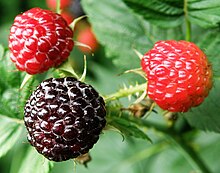
Rubus Occidentalis (also known as wild black raspberry, black caps, thimbleberry, and scotch caps) is a very common plant in western New York state (where I live). The official range where black caps can be found in the wild is through out North America. They very closely resemble raspberries. Like the raspberry, they share the white underside of the leaves, a fruit that is made up of druplets, similar flowers, and the thorny stems. It is argued that black caps have more thorns on their stems than raspberries. I personally don't know if this is true.
Black caps are ripe around midsummer in my region. As a child, I would go out with my brothers and pick them for our Mom to use in jam. We regularly at about half of what we picked. I was taught that the leaves picked around midsummer had the proper medicinal quality to treat premenstrual cramps and help lift the depression that women in my family experienced due to their menses. I was told that if you drank black raspberry leaf tea not at these times, it acted as a mild sedative.
We were taught that the fruit, consumed in large quantities, had a laxative effect. And, honestly, that one is absolutely true. It didn't stop my brother and I from eating what seemed like half our weight in black caps when they were ripe. At one point, one of us (I don't remember now if it was myself or one of my brothers.) was struggling with constipation. Our grandmother gave three teaspoonfuls of her black raspberry jam. It was no longer a problem after that. It was, however, not as effective as the plum jelly.
We were also taught that by looking through the canes of the plant around sunset, we could see nature spirits moving about the land. We were also taught that picking unripe berries off the plant discourages it producing more on that cane next year. The one bit of folk lore that made the biggest impression on me was one that came from one of my aunts. She told me that the Queen of the Fairies had her summer chariot made from a whole black cap berry, (The winter one being made from half of an empty hazelnut.)
Daucus Carota1 is one of the most widely domesticated plants in the world. Most people are familiar with it by its most common name, Carrot. It is in the same family of plants as Queen Anne's Lace, as is evidenced by their similar flowers, leaves, and root structures. It is also known as Bird's Nest because when the flowers finish blooming, the umbel curls inward and resembles a cupped bird's nest.
Carrot is well known to the world since antiquity. It has been mentioned in the writings of the ancient Romans and Greeks under different names. This leads to some confusion for modern translators of these texts because in several cases, it is unclear if the Carrot is what was mentioned or if they were referring to Parsnip or Skirret. (Both Parsnip and Skirret are related to Carrots.) Specific breeding of Carrot varieties over the course of history has given rise to what is served commonly at the table.
The domestic Carrot is larger, sweeter, and less woody textured than wild Carrot. There are cultivars of domestic Carrot that are orange, yellow, purple, and white. Wild Carrot is predominantly found to have a white root, though the other color varieties do occur. The whole plant is suitable for consumption. The leafy tops are edible when they are young. As the plant ages, the upper portion of the Carrot becomes bitter and contain toxic alkaloids. The roots are used as a food staple around the world. The blossoms and the seeds have a folk medicine application as a contraceptive.
The medicinal applications of Bird's Nest have varied over the course of history. It has been used a laxative, vermifuge, and poultices to treat a wide range of disorders. It was especially known as a good treatment for liver disorders. This plant has strong antiseptic properties and discourage putrescent changes in the body when consumed.
When it was introduced to England, it was received with great enthusiasm due to the difficulties in that region with growing produce, as compared to continental Europe. Interestingly, however, its uses moved beyond that as a food stuff or medicinal product. During the reign of James I, it enjoyed a period as a fashionable accessory in the elaborate hairstyles of the era. In these instances, the top of the plant with its delicate leaves was used.
In folk magic, Bird's Nest is often used to impart infertility but it also, paradoxically, can be used to assist fertility magic as well. Due to its resemblance to an erect penis, it has been considered a male aphrodisiac. Some have also used forked Carrot roots in place of Mandrake as poppets for their magical workings. They also have acquired a reputation as something that encourages healthy eyesight. Part of this reputation is based upon the presence of lutein and partly upon the sympathetic magical association with the eye based upon a cross section of the taproot.
~*~*~*~*~*~*~*~*~
1. I've been informed that the Daucus Carota is not the same as domesticated Carrot. The name of that plant is Daucus Carota (Sativus). It is a unique subspecies of Daucus Carota. Do not consume the upper portions of Daucus Carota because it is toxic. The young roots of Daucus Carota are edible but become woody and unpalatable as they age. Thank you to M. Robinson for pointing this out.
My sources are M. Grieve's A Modern Herbal (Volume I for today's posting) and what I have found at sites such as Wikipedia and fact pages about plants hosted by educational sites such as Cornell Univ.