Blurb

Thoughts, lessons, and theology from an eclectic witch from a varied background.

Sunday, January 12, 2014

Polytheism & Filianism

From Here
A while back, I discussed in brief how I am a polytheist and that I follow the Filianic/Deanic faith as well. I thought that I'd take a little time today to explain this in a bit more detail and how it is not the 'div0 error'[1] it might seem to be. If you take a moment to consider the theology[2] of this seemingly monotheistic faith, it [3] it is my understanding that Dea will manifest her presence as male or female.
becomes apparent that within Filianism and Deanism one finds that Dea is understood to manifest in many different ways. As we live in a world where there is a masculine and feminine genders

By the same mystery that allows for the Mother, Daughter, and Deam Mysterium can be three independent forms of Dea and one, the same function allows for the gods of the world to exist as many and independent deities. They are unified by their nature as deities. Additionally, there is some sort of mystic connection, in my understanding and perception of it all, that binds them all to each other and makes up a singular entity which is both possessed of the characteristics that we comprehend of Dea and that which simply surpasses our ability to understand.

Each deity that I interact with is sovereign in their sphere of influence and can reach out of it to interact in other areas. At the same time, I do not see the divisions of different deities as mutually exclusive things. All forms of deity make up the Divine. All forms of deity, as part of the Divine, possess elements that we can not comprehend. Reverence given to one deity is no different at its core then reverence given to another because in the end, all honor is given to the Divine that is beyond our comprehension.
From Here

Some Wiccans call this Akasha. They identify the central point of the circle space with it. Some people speak of the fluid spiritual energy that moves through the universe as akasha. I don't think that the Divine, which I understand to be Dea, is the same as akasha. I don't know what the correct term for this would be, perhaps quintessence. The matter of this spiritual energy, however, is a subject for another day.

I revere Dea. I also revere Freyr and the other gods of the Norse pantheon. I do not believe they are mutually exclusive. I believe that they are all part of the same collective numinous whole that we simply can not fathom. Indeed, it is this whole which I refer to as the Divine is what makes all religions of the world valid.

In the end, all roads lead home.

~*~*~*~*~*~*~

1 div0 = divide by zero, something of a joke that I picked up in my travels. Beloved is a computer programmer by vocation and this is something he regularly encounters.

2 I use the term theology rather then thealogy because it's more easily recognized, some concept different genders for each term. Theology = the study of god  Thealogy = the study of goddess

3 Binary gender division is used for the sake of simplicity. Perhaps in a later entry, I will address fluid gender states and my faith.

Wednesday, January 8, 2014

Schools of Magic

A school of magic can be defined as a discipline of magical study that is distinguished by techniques,
From Here
equipment, and focus of inquiry. It is possible to come up with a nearly inexhaustible list of schools of magical study. Some of these schools have roots that go back into deep antiquity. Others are purely modern pursuits that are shaped by the sensibilities and considerations of modern occult thought. Magic can be defined as high or low magic. This also has a degree of influence on how a school of magic is comprehended.

Generally, high magic is understood to have a very strong ceremonial aspect to it and a focus upon abstract concepts. Low magic, on the other hand, is understood to have a more improvised element and focuses on more concrete ideas and immediate concerns. There are schools of magic that lend themselves towards highly ceremonial magical study. Frequently, high magic that is focused upon ceremonial elements is the heritage of ritual magicians of earlier eras. Low magic tends to manifest most frequently as folk magic.

The schools of achemy, theurgy, and ceremonial necromancy could be classed as high magic. Many modern spirit manipulative magic, chaos magic, and technologically based magic fall under the category of modern folk magic. Each school of magic has their own specialized set of tools and practices. Each has their own traditional focus of inquiry. While there are components from each school that can be applied to other schools, the primary practices are what is considered when determining if something is part of a given school of magic.
From Here

Alchemy is perhaps one of the oldest forms of magical study. The language of alchemy is specialized and can be difficult to make sense of with out an understanding of what the symbolism used means. This specialized language makes the texts that we have access to difficult to comprehend but it is also a mark of high magic. Many of the tools of alchemy, such as the alembic, have persisted into modern day, non occult use, morphing into the recognizable laboratory equipment.

Theurgy, which is argued to be a forerunner of alchemy, is the ritual invocation of deity and spiritual beings for magical purpose. It is from here that ceremonial magicians acquired the use of ritual circles and sigils. Additionally, the practice of invocations of a formulaic nature are derived from this school of magic. When one considers the works of John Dee and his recording of Enochian magic, it is possible to see how his work is heavily influenced by earlier techniques that are alluded to in the Malleus Maleficarum and related works from the Burning Times.

Both alchemy and theurgy have fairly standardized ritual practices within Western culture. They have their respective foci upon the refinement of the soul and the union of the soul with the divine. Each system of magical study has their own specialized language and symbolism. They are also shown to have their own set of tools.

Chaos magic has no standardized ritual format. It incorporates elements that a given practitioner feels would prove useful to them. It is very individualistic and experientially based. The focus of study ranges wildly, though trends suggest that a study in the manipulation of time is currently popular. There is a lack of unique tools, terms, or symbolism. The individual practitioner (sometimes known as a chaote) uses whatever means proves expedient.  As such, there is no set of required elements or correspondences used.

Technological magic has grown up alongside chaos magic. With the advent of computers, there are many modern occultists who employ this tool extensively. Their work has very few unifying qualities. The focus of inquiry is as varied as the practitioners themselves. Technological magic uses available technology as the vehicle by which occult elements are engaged and manipulated. A fine example of this is the use of Google as a divination tool. The search engine can be used in a randomized fashion much like a bible is for bibliomancy. The first result is generally the answer to the query.

There are countless different ways to divide the study of magic and the philosophical lines of inquiry engaged by occultists and magicians. Categorizing them by their common elements, it is possible to define general schools of magical study and philosophy. Unfortunately, there is no standardized discussion of magical schools of thought. As such, the organization of one's research into respective schools will be different for each person engaged in study.

Tuesday, January 7, 2014

Feast of Epiphany

From Here


A Chapel of Our Mother God notes that epiphany is sometimes referred to as the 'little nativity'. One of the winter celebrations and of the 'low' festivals of the Deanic and Filianic faiths, the feast of epiphany marks when the world was given a vision of the Mother and the Daughter. It is the first time since the 'fall' of maid that Dea is glimpsed directly. Within the sacred drama, the vision of epiphany fulfills and foreshadows the Maiden's actions as Redeemer of the World.

It is but by the virtue of the Maiden that the blinding brilliance of the Mother is softened such that we might gaze upon Dea. The Sun, in her brilliance, is considered a metaphorical cognate of the Mother. The Moon is the symbol of the Maiden. Just as a total solar eclipse permits us to look safely at the Sun, so does the Maiden serve to make the brilliance of the Mother less overwhelming.

The Maiden's girlhood is not spoken of in the Gospel of Our Mother God. Some would say that it is secondary to the work the Maiden undertakes as Priestess and Princess of the World. Others would contend that it is a mystery that knowledge of has been lost in this Age. For my part, I understand the girlhood of the Maiden as something that is revealed as She chooses to those who would engage her as the Holy Child.

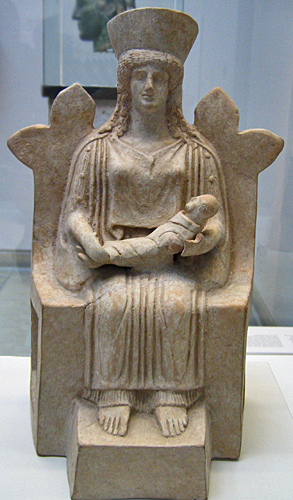
The iconography of the Blessed Mother and the Christ child appeals very strongly to me. Children of the age that the Christ child is portrayed in most versions of this image are very difficult to determine gender because it is before the obvious secondary sex characteristics present. As such, I see images like the one below as images of the Mother and the Maiden. I contemplate them and I find myself both deeply moved as a mother and a daughter.

From Here
I look at the child curled up against their mother and I have a visceral recollection of holding my infant sons. I am left in a state of wonder at the idea that a goddess might be so tiny. I find myself curious if she was as helpless as my sons were. I wonder if the Mother had her heart in her throat as she watched the Maiden toddle about and grow to full stature.

I mark the feast of epiphany with some solemnity. I spent a good portion of my day, where I could, in meditation on the Daughter and my place in relation to her and the Mother.

May Dea bless you and keep you in her hand.

Saturday, January 4, 2014

New material coming soon!

Hi folks!

From Here
There has been a great deal of upheaval in my house of late. First came the fun of the kids being off from school, then the holidays, and then everybody got sick. To say the least, I simply didn't have the starch in me to update here or any of my other blogs. This Tuesday, I will have some new material to share. As always, I am more then willing to answer any questions that you might have. Just shoot me a quick message via the comments.

I hope that this finds you all happy and well.

Dea Bless!

Friday, December 13, 2013

Question Time: Is the Dark Queen the same as the Snake?

Miss R. Stephens asked the following question in a community that we're both part of.
As a newbie to Filianism, I may have made a connection that is either totally preposterous and misguided or really super obvious to the rest of the faith that I just haven't caught onto before, and I'd like some input! A few nights ago, I was reading through the Scriptures again, and it struck me that first daughter of the Mother embraced the 'snake' or the darkness that was before things were created, and the outpouring of her energy/creative power gave this darkness a shape, a body 'like hers.' In at least one version of the Scriptures, I know the Snake is written as 'he.' But here I wondered - a body like the daughter's. Wouldn't that mean a female body? And then as I read further along, and went through the story of the Daughter descending into Hell and seeing the Dark Queen, I also thought - what if this is the same snake? In the body that the first daughter gave it? I had previously thought this was the Thea-Beyond-Form, since I've seen her referenced as the Dark Queen. But now I wonder if this is the same? It would make sense. . . . . like I said before though, this is probably either absolutely ridiculous or something really obvious to other believers. So. Give me your thoughts. Did I read this the right way or I am missing something??
Before I give my thoughts upon this, I wanted to share the position of the esteemed Bishop Georgia Cobb, who is head of the Elegant Lady Feminine Seminary, of which I am a member. She writes:


The Snake is not a person (he or it or she).  The snake is a concept.  The concept is "distraction: from Dea and Her Divine Will.  It is the "space" between that which Dea has Created and that which she allows to happen (i.e. the consequence of free thought and free will). Embracing the snake (embracing those things which "distract" ; her from looking to Dea for guidance) does not give the snake ("distraction") a life of it/his/her own.  It is only a weight which drags the soul of the first maid away from Dea.  This weight, takes on the shape of she who embraces it.  But this weight (distraction) does not then become a person like the first maid (nor does it enter into a relationship with her). 

This is not the same story as is told in the Palagians Myth in which the Goddess Eurynome has an intimate relationship with a snake (the north wind) as is impregnated by it/him.

The Dark (Evil) Queen is not the same as the Dark (Mysterious) Mother aka Dea Beyond Form, The Absolute Deity, The Darkness Beyond the Light and the Light Beyond the Darkness). 

The Dark Queen is not the snake. 

The Dark Queen is another concept which represents the power of Evil, that which is furthest away from Dea (Goodness and Light).

The Mythos of the Divine maid is a mystery, not a history lesson.
The question of the relationship of the Snake and the Dark Queen to Dea can be difficult to understand. To examine this more fully, let us take a moment to look at the scriptures in question. The first one we consider is that of the Creation. In chapter two, verses six through nine, it speaks of how the First Daughter of Dea embraced the Snake and that it took on 'shape like hers.'

Now, just as Bishop Cobb noted, the story of the Creation is not an entirely literal story. Much is detailed here that is difficult to see as literal events. In my consideration and meditation upon the elements of the Creation story, I too struggled with the concept of the Snake. I then realized that the Snake is an allegorical figure. The First Daughter and the events surrounding her are also allegorical.

The Snake symbolizes that which is not of Dea. Bishop Cobb describes the Snake as an aspect of the power of Evil. It could also be understood as the essence of self deception. In engaging in self deception we 'embrace' the Snake. One who is completely given over to their self deception has taken the Snake in their arms and cut themselves off from Dea.

Additionally, the Snake can be understood as the illusion of the world. It is the pleasant lies that we tell ourselves about life and how the world operates. By immersing ourselves in these deceptions and giving them our thought energy, we give 'form' to the Snake. It is something like an egregore and the more thought we give it, the more powerful it becomes.

Now, the second set of scripture verses that we consider come in the Mythos of the Daughter. In chapter five, verses twelve through nineteen, the Daughter is confronted by the Dark Queen. Again, we must consider that the story of the Daughter's decent into Hell is not like the story of Jesus of Nazareth. The Daughter and her mythos take place outside of the scope of history. It is like the Creation story, a tale intended to reflect the greater truths by way of symbols that we might understand.

The Daughter's confrontation with the Dark Queen could be rephrased as the Divine's confrontation with that which opposes it. Within the Filianic understanding of the universe, the Divine confronts that which opposes it for the sake of all that is. In confronting opposition, the Divine suffers as that which exists does. Then, by way of Grace and Love, the Divine is restored to wholeness, and in the process restores all of existence to wholeness.

The Gospel of Our Mother God speaks of a term 'khear'. Khear is not only the Snake within the context of the Creation story. Khear is the Dark Queen and her daughters. Khear is akin to the concept of sin. It speaks of the abyss that divides all of existence from Dea. That abyss is understood to have opened up between existence and Dea when the first essence of existence turned from Her and embraced the Snake.

The mythos of the Daughter speaks of how that abyss is bridged by the Daughter's death and resurrection. Additionally, we are cautioned within the Gospel to be vigilant and mindful of how we tend to turn away from the Truth. We are called upon to repent and correct our ways. We are also called upon to reach out to the Daughter for aid, because while we are frail and fallible, Dea herself might bring us into her arms.

There are elements of the Gospel that I interpret differently from Bishop Cobb. Like her, I agree that the Snake and the Dark Queen are separate emanations of the antithesis of Dea. I, however, do not see them as beings of pure evil. I see them as beings of pure illusion. If we can resist the temptations of the lies about reality, then we might learn to see truly.

Evil is not an intelligent thing. It is a trait. Can the Dark Queen and the Snake be perceived as evil? Yes. That is possible.

I can not separate reality from Dea. She is present in all things. As such, the Snake and the Dark Queen are some how bound to Her. I understand the Snake and the Dark Queen to be illusions. I understand evil to be the actions of humanity. Once we master illusion and see things for what they are, we see that there is only Dea.

Wednesday, December 4, 2013

Iconography of the Goddess.

In my earlier post, you may have noticed that I have an image of St. Anne and the Blessed Virgin Mary. What you may have figured out is that I am using this iconography to represent the Mother and the Daughter of Filianic faith. Borrowing images from established traditions is a frequent thing in the representations of the Goddess. It happens in almost every tradition or faith within the western world that involves a goddess figure.

In some cases, this is a symbolic reclamation of earlier iconography that has been carried forward through the traditions of other faiths. This is most frequently the case with Catholic Christian imagery. In other cases, the imagery of other faiths are recast with different meanings. An excellent example of this can be found in the use of various Catholic Christian devotional images within Voudon. (This is not with out precedent, for the early Catholic Church quite famously took Isis statues where she is nursing Horace and recast them as Marian images.)

While there are parties at work on building a modern vision of the Goddess in her many manifestations, I would kindly ask for others to view our borrowing of their iconography as a way of honoring them. We uphold these images so highly that we understand them to represent the fundamental truth of our deities. We treat them with respect and have as much love for them as you, though it may be for different reasons and seem rather odd to you.

Pagan Advent.

The advent season is upon us. For the Christian community, advent is a time of preparation and anticipation for the celebration of the nativity of Jesus Christ. Within the pagan community, a similar time of preparation is observed, but this is in preparation for the celebration of the winter solstice.

Within the Filianic faith, the advent season is a time of preparation and anticipation of the birth of the Daughter. It is, what some would call, a pagan advent. The Filianic calendar begins their advent season on the first of the month Astrea (Nov. 28th according to the Julian calendar). On this day, many of the Filianic faith will begin their decorating and preparing their homes for Nativity. On the eleventh day of Astrea (Dec. 8th), is the feast of the Conception of the Daughter.

I celebrate the Filianic advent season as a time to honor the Lady. As such, the Mother and the Daughter are equally honored in my home this time of year. I am in the midst of also preparing something special for Yule.  For, I am not only eagerly awaiting the birth of the Daughter, I also am preparing and awaiting the rebirth of the Sun child.

Image from here.