Blurb

Thoughts, lessons, and theology from an eclectic witch from a varied background.
Showing posts with label Eastre. Show all posts

Saturday, March 19, 2016

Easter rant.


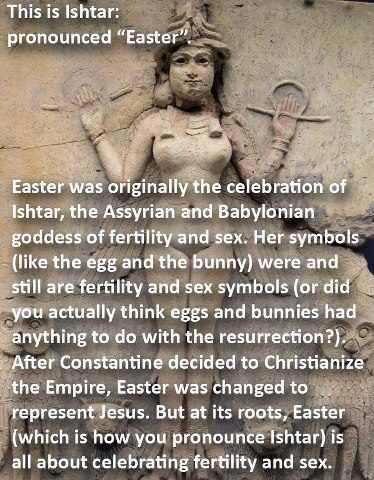
If you are on Facebook or generally run with a pagan crowd via social media, the above image may have flown across your screen. It's become something of an annual thing. I first saw this a few years ago. I twitched a little bit and then continued on with my day. Now, it seems I can't get away from it this year. So, rather than merely twitching, I'm going to give my response to it. (Spoiler: I'm not happy.)

There are so many things wrong with this on so many levels. Revisionist history irritates me to no end. Intentional mangling of information and presenting it as fact makes me furious. This is a meme that I keep seeing reposted with the intent to 'set the record straight' about Easter. I confess, I get angrier each time I see this. I can appreciate the desire to demonstrate the pre-Christian roots of this celebration. I can even appreciate the desire to normalize pagan faiths. You don't do that by way of bullshit. A few minutes of fact checking and this is revealed to be utter garbage.

Ishtar is not connected with Easter in even the remotest fashion outside of this meme. The name Ishtar is pronounced entirely differently than the word Easter and comes from a completely different culture. She is indeed an Assyrian, Babylonian, and Akkadian goddess of love, war, fertility, and sex. Ishtar is believed to be a cognate to Innanna and Astarte. (They are Sumerian and Aramean goddesses, respectively.) Her name is understood to be pronounced 'ish-tar' given what we have been able to do with reconstructing the ancient language that her name comes from. The egg and the 'bunny' are not her symbols. She is associated with lions and a seven pointed star. 

The closest we can come to an association with the spring season is the myth of her descent into the underworld. This myth is considered to be a part of seasonal worship patterns with Ishtar's descent associated with the fallow time of year and her return to the upperworld with the return of fertility. This association, however, is not as strong as others would like to paint it. The figure that is tied most closely to the fertility of the land is not Ishtar but her lover Tammuz. Ishtar and Tammuz are a pair that bring fertility to man and livestock (in Ishtar's case) and the land (in Tammuz's case). This, however, is only one interpretation. In another interpretation, Ishtar's return to the upperworld comes when she sends Tammuz in her place to stay with Ereshkigal (Ishtar's sister and the goddess of the underworld) because he did not mourn her absence. The lore is unclear here and the historical record is inconclusive as to which interpretation is correct. There is, however, a growing consensus among scholars that the second variant of the tale of Ishtar's descent is accurate, which would make her the primary deity of fertility.

Now, what does this have to do with Easter? Not bloody much, to be honest. A vague seasonal overlap and some passing similarity in the visual appearance of her name to the term Easter (which only occurs in the English language, from what I can tell) is the best connection you're going to get here. Easter is a word that comes from an entirely different part of the world and an entirely different period in history. Easter has been shown to be derived from the old English term Ostara (which has multiple spellings and can be found in the Germanic people of continental Europe from this era as well). Ostara seems to be connected with a goddess of the same name, though there are functionally no records of her worship.

Ostara is believed to have the hare as an animal associated with her, but there is no solid evidence either way. She is also believed to be associated with eggs, but that connection is equally questionable. The folk practices of Easter are considered by many to be cultural vestiges of the worship of Ostara. Within the modern pagan community, Ostara is observed as the celebration of the Spring Equinox and many give homage to this mysterious deity. These observances, however, have a great deal of overlap with the culturally dominant Easter folk practices. While there is an effort to 'take back' the folk practices, the lore is functionally non-existent and the corpus of devotional activities of mainstream pagans are of modern manufacture.

Now, someone may ask where I personally fall on this matter. It is a fine question and I believe it merits answer. Ostara is a Germanic goddess whose historical cult of worship was in many ways lost by the time Bede wrote of her. I honor her as a fertility goddess. I am of the opinion that she is most likely of the Vanir. It is my belief that she is a mighty goddess that is not directly approached because people are not sure how to approach her. At the Spring Equinox, I pour out offerings for her as I do for the other gods. I ask her blessing upon my efforts over the growing season and upon my growing children. It is my suspicion that children and young of any life form are under her special care. I think that the connection between Ostara and eggs comes because this is when birds begin nesting. 

I also think that my area celebrates Ostara early when we go by the calendar because the birds are not nesting yet, but it is easier for my children to celebrate it in proximity to the Christian celebration of Easter because there is less friction with our Christian community. At the Spring Equinox, I am not only celebrating and honoring Ostara, by the way. I also give offerings and celebrate Freyr and Gerda. It is my sincere belief that this is the time of year that Freyr returns from Helheim to his bride. Thus, I make a point to pay homage to them as well at this time of year.

If you want to point at the pagan origins of Easter, that's great. Let's look at the real origins rather than this bad fiction meme.

Tuesday, March 24, 2015

Eastre & Equinox = Renewal & New Beginning


The Vernal Equinox is the time when Spring officially begins. It is also the (approximate) date of the celebrations of Eastre and Ostara. Eastre is not to be confused with the Christian celebration of Easter. While the two holidays share the name and similar themes, the Filianic holiday of Eastre is different from the Christian holiday of Easter. Ostara is celebrated within the pagan community by many different faiths. It is well known in the Wiccan community and derived from the ancient Germanic pagan holiday of the same name. I celebrate Eastre and Ostara around the time of the Equinox, though I am considering moving my observance of Ostara to coincide with the Christian celebration of Easter for the sake of ease.

At Eastre, within the Filianic faiths, we observe the death and resurrection of God1 the Daughter. The Festival of Eastre is a multiple day event. It begins on the last day of the month/season Moura. This day is named for the destroyer face of the angel2 Werde, Kala. Kala is the last day of the liturgical year. It is also the day where the Daughter is slain by the Dark Queen. This is a day that is inauspicious for beginning new activities and planning future events. After Kala is a period that is not part of the liturgical year, as it is considered to be a time outside of time called Hiatus. Hiatus is one day (except during leap years, then it is two) out of the Julian calendar and is the time where the Daughter hangs upon the pillar of the Nether World in absolute death.

At Hiatus, the world is considered to be ended by most Filianic communities and it is a time of mourning. Prayers are made to God the Mother for the return of God the Daughter and the renewal of the world. Hiatus is a time where a taboo is extended for the worshiper of Filianic faiths to not consider the future because technically there is no future at this time. Starting at Kala and through Hiatus, all icons and statues of God the Daughter are veiled to reflect her absence from the world and her death. In my observance of Kala and Hiatus, I veil my icons of the Daughter and extinguish the light that I have for her presence in the world.

This light remains darkened for the totality of this observance to reflect that the Daughter is dead and gone out of the world. I also make a point of not burning any new offering candles during this period. Because I still feel that I should give offerings and candles is one of the few things I can readily afford, I use one big pillar or jarred candle that will last me through out the final week of Moura and into Hiatus. I keep my candles in the liturgical colors for Moura (purple/black). At Eastre proper, the icons are revealed and I dispose of the candle that I had been burning through Moura and Hiatus. I replace it with something in a 'spring' color and I try to find one that is floral in scent. (This year a sunny yellow that smells of honeysuckle.)

I also relight my candle/light for the Daughter's presence in the world because at Eastre, the Mother rescues and revives the Daughter, thus returning her to the world. With the resurrection of the Daughter, all of the world is considered to be renewed. This day is the first day of the liturgical year and a day of celebration.
Eastre does not fall technically on the equinox but it is within the time frame that the equinox happens. Just as spring begins in the solar year and in the Julian calendar, spring in the Filianic calendar begins with Eastre. It is considered an especially auspicious day for starting things.

Ostara comes from the ancient Germanic holiday of the same name. It is a time where the goddess for which this holiday is named brings spring's renewal into the world. She is accompanied by her sacred animals (the rabbit and birds) and brings warmth and new life with her. At Ostara, I not only honor this ancient goddess but I also celebrate the return of Freyr. During the winter months, he is often considered to be residing in the realm of the dead following his slaying during the autumn harvest. With the renewal of the 'life' of plants, I consider it to be when he returns from that time.

For Ostara, I put fresh flowers on the altar and ask that my gardening efforts and houseplants be blessed by both Ostara and Freyr. (I also ask for Gerda's blessing for good measure as well.) I also give offerings of sweet things, bread, and alcohol. This is also when I do my own little version of the charming of the plough. While the Asatru community celebrates this holiday in February, I observe it at the time of the equinox because this is when farmers in my area are actively preparing for the ploughing and planting of the fields. While I haven't a plough to bless, I bless my gardening tools (usually one in representative of all) for healthy plants and good harvest.

It is good to note that Eastre, Ostara, and Easter all come from the same linguistic origin. They all are derived from the ancient goddess Ostara (spelled differently for different regions) who was celebrated at this time. When Christianity was in the midst of overtaking native religions in the Germanic regions, the name of this celebration was taken to celebrate the death and resurrection of Christ. Several ancient practices (such as the egg hunt) were tolerated because they were so deeply ingrained into the culture's identity.

Both Eastre and Ostara are important parts of my calendar. It is at this time that I celebrate the renewal of the world with the beginning of spring. It is also when I set out to begin changes in my life. Where most people in the secular world begin at the first day of the Julian calendar, I begin at the first day of the Filianic calendar because I wish to ride the magical tide that comes with the equinox and draw to me the blessings of the season as well.

~*~*~*~*~*~
1. This is a direct reference to how the Filianic/Déanic community as reflected by www.mother-god.com refers to the goddess whom I follow known in her three aspects as Mother (Marya), Daugher (Anna/Inanna), and Dark Mother (Deam Mysterium). The conflict over the terms god/goddess will be addressed in another post.

2. I use the term angel rather then the term janya (pl. janyati) because it is more familiar to the community at large. While the terms are not completely interchangeable, it is close enough for my purposes.